
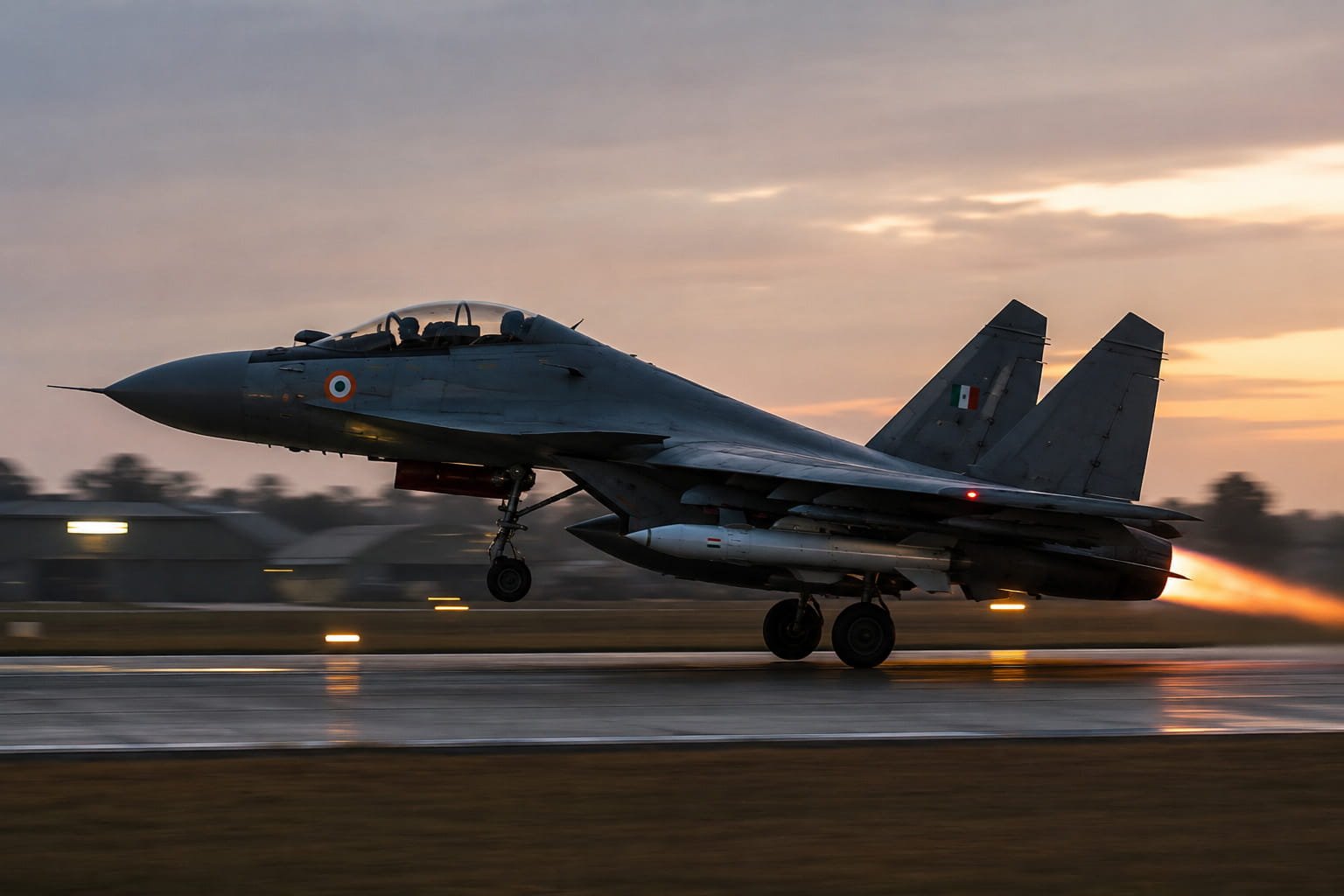
- India achieved another milestone in its indigenous missile programme on Tuesday (2 June) as the Defence Research and Development Organisation (DRDO) and the Indian Air Force successfully conducted flight-tests of the RudraM-II air-to-surface missile from a Sukhoi Su-30MKI fighter off the coast of Odisha.
- The tests were conducted under extreme release conditions with critical flight trajectory to validate all the subsystems.
- The missiles after release were guided to a predefined target with pin-point accuracy, with all test objectives fully met as confirmed by flight data captured by various range instruments deployed by Integrated Test Range at Chandipur.
The indigenously developed RudraM-II air-to-surface missile is capable of achieving speeds of up to Mach 5.5, engaging targets at ranges of around 300 km, and carrying a 200-kg warhead.
- It can be launched from fighter aircraft such as the Sukhoi Su-30MKI operating at altitudes between 3 km and 15 km.
- RudraM-II employs an advanced hybrid guidance architecture that integrates an Inertial Navigation System, GPS-based navigation, and a sophisticated passive homing seeker capable of detecting and tracking radio-frequency emissions across a broad spectrum, enabling highly accurate strikes against enemy radar and air-defence assets.
- The new missile will act as a key force multiplier and intend to eventually replace the older Russian-origin Kh-31 anti-radiation missiles currently in service.
- RudraM-II has been indigenously developed by Research Centre Imarat, Hyderabad, as the nodal DRDO laboratory in collaboration with other sister labs such as Defence Research and Development Laboratory, High Energy Materials Research Laboratory, Armament Research & Development Establishment & ITR.
Along with the Development cum Production Partners (DcPPs), agencies like Hindustan Aeronautics Limited, Regional Centre for Military Airworthiness, Missile System Quality Assurance Agency and many other industries have contributed significantly towards achieving this goal.