
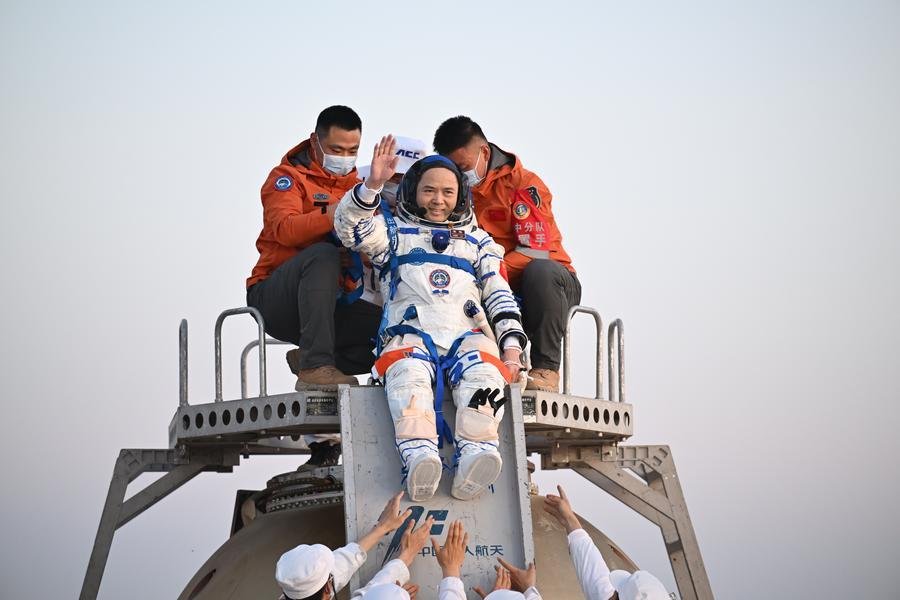
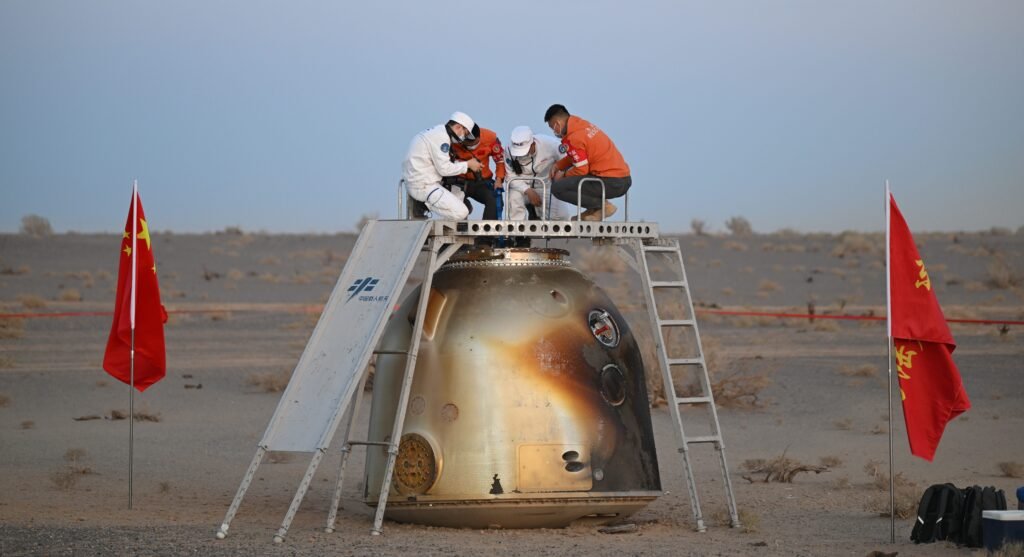
Three Chinese astronauts of the Shenzhou-21 mission successfully returned to Earth on 29 May 2026 after spending 210 days in orbit aboard China’s space station. The crew landed safely at the Dongfeng landing site in the Inner Mongolia Autonomous Region of northern China, marking another important milestone in China’s growing human spaceflight programme.
The mission demonstrated China’s expanding capabilities in long-duration space habitation, scientific research, and space station operations.
The Shenzhou-21 mission crew consisted of:
- Zhang Lu
- Wu Fei
- Zhang Hongzhang
The astronauts lived and worked aboard the Tiangong Space Station for nearly seven months, conducting scientific experiments, maintenance activities, and spacewalks.
China’s Shenzhou Programme and Tiangong Space Station:
The Shenzhou Programme is China’s crewed spacecraft programme designed to send astronauts into space and support long-term human spaceflight missions. Since its first crewed mission in 2003, the programme has become a key component of China’s space ambitions.
The Shenzhou spacecraft is capable of:
- Transporting astronauts to and from space.
- Supporting long-duration missions.
- Docking with space stations.
- Carrying scientific equipment and supplies.
Tiangong (“Heavenly Palace”) is China’s modular space station operating in low Earth orbit. It serves as a permanent orbital laboratory for scientific research and technological demonstrations.
The space station supports:
- Long-duration crewed missions.
- Microgravity experiments.
- Space medicine and life science research.
- Earth observation and technology testing.
- Extravehicular activities (spacewalks).
Tiangong is an important symbol of China’s independent human spaceflight capability and long-term space exploration goals.
Mission Timeline:
The Shenzhou-21 crew was launched on 31 October 2025 to replace the astronauts of the Shenzhou-20 mission aboard Tiangong.
During their stay, the astronauts carried out scientific research and station maintenance while ensuring the continuous operation of the space station.
The crew was later replaced by the Shenzhou-23 mission, which was launched on 24 May 2026. After the successful crew handover, preparations began for the astronauts’ return to Earth.
Unusual Return Arrangement:
The astronauts returned to Earth using the Shenzhou-22 spacecraft rather than their original Shenzhou-21 capsule. This occurred because the original Shenzhou-21 spacecraft had been used by the Shenzhou-20 crew for an earlier return mission after damage associated with space debris affected normal spacecraft operations.
As a result, the Shenzhou-21 astronauts remained aboard Tiangong until the arrival of Shenzhou-22, ensuring uninterrupted crew presence on the station.
This demonstrated China’s ability to manage contingencies and maintain operational flexibility in space missions.
Scientific Activities and Spacewalks:
During their 210-day stay, the Shenzhou-21 astronauts conducted a wide range of scientific and technical activities.
The crew successfully completed three spacewalks (Extravehicular Activities – EVAs). These missions involved:
- Inspection of station components.
- Installation and maintenance of equipment.
- Testing technologies required for future space operations.
The astronauts carried out numerous experiments in areas such as:
Microgravity Fundamental Physics
Researchers studied how physical processes behave in the near-weightless environment of space. Such experiments help scientists understand phenomena that cannot be easily observed on Earth.
Space Life Sciences
The crew conducted studies on:
- Human adaptation to long-duration spaceflight.
- Biological responses to microgravity.
- Space medicine and astronaut health.
- Growth and development of living organisms in space.
The findings are expected to contribute to future long-term missions, including potential lunar and deep-space exploration programmes.
Significance of the Mission:
The successful completion of the Shenzhou-21 mission highlights China’s continued progress in human spaceflight and space station operations. The mission demonstrated:
- China’s ability to sustain long-duration human presence in space.
- Effective management of crew rotations aboard Tiangong.
- Advancement of scientific research in microgravity conditions.
- Enhanced experience in conducting spacewalks and station maintenance.
- Greater preparedness for future lunar and deep-space exploration missions.
The mission further strengthens China’s position as one of the world’s leading spacefaring nations and showcases the growing importance of the Tiangong Space Station in global space research and exploration.